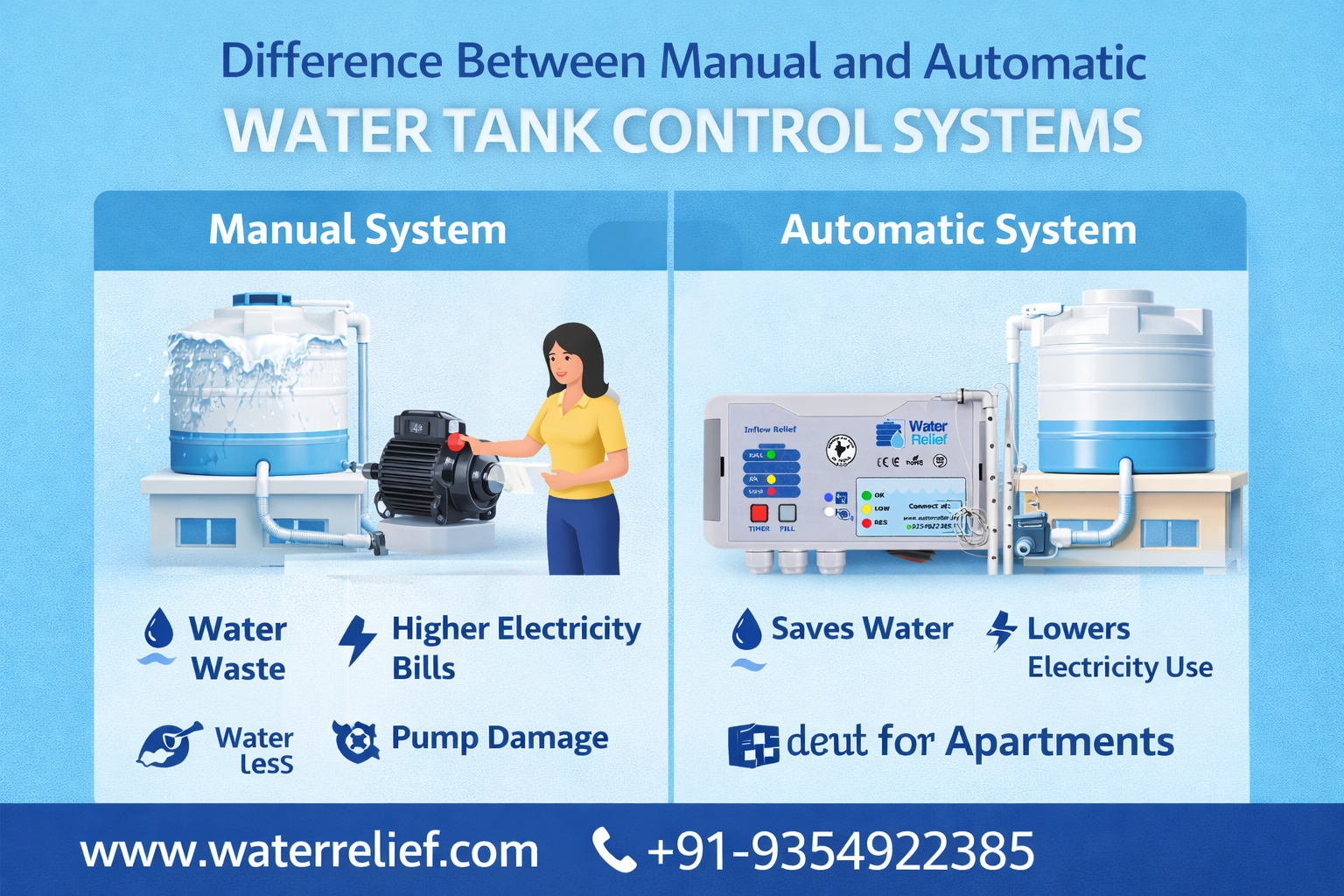
Water management is an essential part of every home, especially in countries like India where overhead tanks, borewell systems, and municipal water supply are commonly used. Many households still rely on manual methods to control water pumps, while others are shifting toward automation. Understanding the difference between manual and automatic water tank control systems can help homeowners make smarter decisions for long-term savings and convenience.
Water Relief offers advanced automatic water tank control solutions designed to eliminate the problems associated with manual water handling.
What Is a Manual Water Tank Control System
A manual water tank control system is the traditional method where a person operates the water pump manually.
In this system:
-
The motor is switched ON when the tank is empty
-
The motor is switched OFF when the tank is full
This method completely depends on human attention and timing.
Problems with Manual Water Tank Control Systems
While manual systems are simple, they often lead to multiple issues in daily life.
1. Risk of Water Overflow
People often forget to switch off the motor after the tank is full.
This causes:
-
water overflow
-
wastage of water
-
damage to walls and roofs
2. Electricity Waste
If the pump runs longer than required, electricity consumption increases unnecessarily.
3. Pump Damage
Manual systems do not protect against:
-
dry running
-
overheating
-
excess load
This reduces pump life.
4. Daily Effort Required
Someone needs to monitor tank levels every day.
This becomes inconvenient over time.
What Is an Automatic Water Tank Control System
An automatic water tank control system is a smart device that controls pump operation automatically based on water levels.
It uses sensors installed inside the tank to detect water levels.
When the water level drops:
-
the pump starts automatically
When the tank becomes full:
-
the pump stops automatically
Water Relief provides reliable automatic systems designed for daily household use.
Key Features of Automatic Systems
Automatic systems offer multiple advanced features such as:
-
automatic motor ON/OFF
-
water level sensing
-
dry run protection
-
overflow prevention
-
consistent water supply
Water Relief ensures these features work smoothly in real-life conditions.
Manual vs Automatic Water Tank Control Systems
Let’s understand the key differences clearly.
1. Operation
Manual system:
-
controlled by human effort
Automatic system:
-
works automatically without intervention
2. Water Efficiency
Manual system:
-
high chances of water wastage
Automatic system:
-
prevents overflow and saves water
3. Electricity Usage
Manual system:
-
pump may run longer than needed
Automatic system:
-
runs only when required
4. Pump Safety
Manual system:
-
no protection from dry running
Automatic system:
-
protects motor from damage
5. Convenience
Manual system:
-
requires daily monitoring
Automatic system:
-
fully automated operation
6. Reliability
Manual system:
-
depends on human memory
Automatic system:
-
works consistently every day
Water Relief clearly provides a more efficient solution compared to manual systems.
Why Automatic Systems Are Better for Modern Homes
Modern households are moving toward automation to improve efficiency and reduce manual effort.
People already automate:
-
lighting
-
appliances
-
security
Water management should also be automated.
An automatic water tank control system provides:
-
better convenience
-
improved water usage
-
reduced utility bills
Water Relief makes this transition easy for homeowners.
Cost Comparison: Manual vs Automatic
Many people think manual systems are cheaper.
However, long-term costs tell a different story.
Manual System Costs:
-
water wastage
-
higher electricity bills
-
pump repair expenses
-
maintenance issues
Automatic System Savings:
-
reduced water usage
-
lower electricity bills
-
less maintenance
Water Relief helps homeowners save money over time.
Suitable Applications for Automatic Systems
Automatic water tank controllers are suitable for:
-
independent homes
-
apartments
-
villas
-
duplex houses
-
residential buildings
They work with:
-
overhead tanks
-
underground tanks
-
borewell systems
-
municipal water supply
Why Choose Water Relief
Choosing the right automatic system is important.
Water Relief is trusted because it is designed for Indian conditions.
Key Advantages:
-
easy installation
-
reliable performance
-
suitable for daily use
-
compatible with different setups
-
low maintenance
Water Relief ensures long-term reliability.
Real-Life Impact of Automation
Many homeowners experience:
-
reduced water bills
-
fewer pump issues
-
better water availability
-
no overflow problems
This makes automatic systems highly practical.
Future of Water Management
With increasing water scarcity and rising electricity costs, smart water management is becoming essential.
Automation helps in:
-
saving natural resources
-
improving efficiency
-
reducing daily effort
Water Relief supports this shift toward smarter living.
Final Thoughts
Understanding the difference between manual and automatic water tank control systems is important for making the right decision.
Manual systems may seem simple, but they lead to water wastage, electricity loss, and pump damage.
Automatic systems offer better efficiency, safety, and convenience.
Water Relief provides a reliable solution that helps homeowners manage water smarter while saving both water and electricity.
For modern homes looking for long-term benefits, Water Relief is a smart and practical choice.
About author


Add comment